 Duluth Water Leak Detection ProsWater leak detection · Duluth, GA · Open 24 hours
Leak Detection vs Plumber in Duluth, GA: Who to Call First
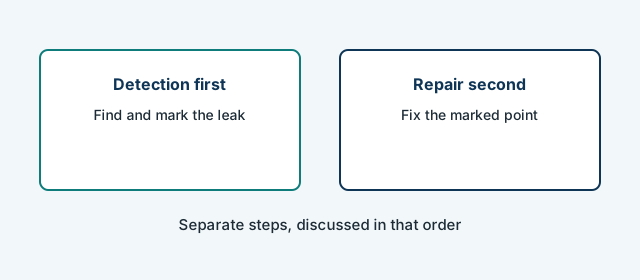
Leak detection in Duluth, GA comes first when the leak is hidden, and a general plumber comes first when the leak is visible. Detection finds and marks the leak. A plumber repairs a known problem. The test is what checks supported the location, not the job title.
Callers often arrive unsure which trade they need, and the confusion is understandable: both trades deal with water, both visit homes, and both talk about leaks. But they do different jobs, and calling the wrong one first can cost time, money, and unnecessary opening. This post explains the difference in practical terms — what each one does, what each one costs you in time and disruption, and how to decide in under a minute from your symptoms.
The one-question test: can you see the leak?
If you can see the pipe and the water — a dripping tap, a visible joint, a toilet connection, a pipe under a sink — the source is known. You do not need a search. You need a repair, and a general plumber is the right first call, because repair is what a plumber's visit is built around. If you cannot see the source — a bill spike, a meter that moves, a damp wall, a warm floor, a soggy yard — you need a search before you need a repair. That search is detection, and it exists precisely because opening walls, floors, or ground to look for a leak is expensive and often opens the wrong spot.
The test works because it separates two different kinds of uncertainty. A visible leak has no uncertainty about location, only about repair method and cost. A hidden leak has uncertainty about location first, and repair cannot be priced or planned honestly until that uncertainty is resolved. Calling a repair trade for a location problem, or a detection trade for a repair problem, mixes those two uncertainties and usually makes both worse.
What a general plumber does best
A general plumber's strength is repair and replacement of known problems: taps, toilets, visible pipes, fixtures, drains, water heaters, and connections you can reach. A plumber can also do useful diagnostic work — checking a toilet, testing a fixture, isolating a section — and many plumbers offer some detection checks as part of their service. The distinction is not that plumbers cannot detect, but that a general repair visit is not built around a full narrowing inspection. Its tools, its time, and its pricing are built around fixing what is already found.
For a Duluth caller, the plumber-first cases are clear: a tap that will not stop dripping, a toilet that runs, a visible joint that leaks, a water heater connection that drips, or a drain that backs up. In each case, the source is visible or localised, and the fastest, cheapest route is a repair visit. Detection would add a search step you do not need, and a detection provider who tried to sell you that search for a visible leak would be selling you the wrong service.
What leak detection does best
Detection's strength is narrowing a hidden leak to a marked point before anything is opened. It uses the meter test to confirm a leak exists, the shutoff test to separate inside from outside, and then acoustic, thermal, moisture, and pressure checks — described in full on the non-invasive methods page — to narrow the remaining section. The result is a location with evidence behind it: a meter result, a section that lost pressure, a thermal pattern, an acoustic signal, or several of those agreeing.
Detection does not repair the pipe. That separation is deliberate, and it is worth understanding before you call either trade. A detection inspection that also sold you the repair would have an incentive to mark a location that suits the repair, not necessarily the location the checks point to. Keeping detection and repair as separate steps — detection first, repair second, with the repair discussed after the location is known — keeps the inspection honest about what it found. Whether the same provider does both steps is a question to ask on the call, after the location is marked, not before.
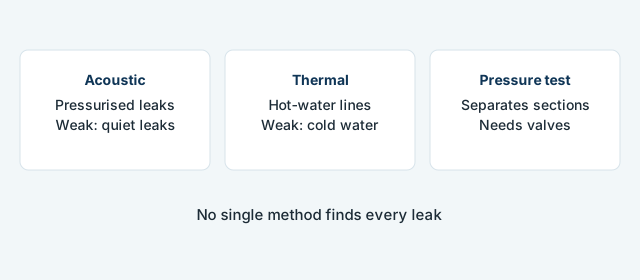
Detection versus plumber, compared
| Question | Detection | General plumber |
|---|---|---|
| Best when | Source is hidden | Source is visible or localised |
| Main output | Marked location + evidence | Repair or replacement |
| Opening | Only at the marked point, later | At the known problem |
| Main risk if wrong first call | Paying for a search you do not need | Opening to search, wrong spot |
| Next step | Repair at the marked point | None, if the repair is complete |
The table is a guide, not a rule about any individual provider. Some plumbers offer full detection, and some detection providers offer repair. The useful question to ask any provider, whatever their title, is the same: what checks will you use, how will you narrow the location before opening, and what will you tell me if the checks cannot confirm a location? A provider who can answer that clearly, in terms of meter results, sections, and methods, is giving you more to go on than a provider who answers with a job title alone.
When to call a plumber first
- You can see the pipe and the water, or you can reach the leaking connection.
- Only one fixture is affected — one tap, one toilet, one appliance connection.
- The problem is a drain, a blockage, or a fixture that needs replacing, not a concealed supply pipe.
- A previous visit already located the leak and you now need the repair done.
- Water is visible and spreading and you can reach a local valve — shut it off, then call a plumber for repair.
When to call detection first
- Your bill spiked, your meter moves, or your pressure dropped, with no visible source.
- A wall is damp, a floor is warm, or a yard patch stays wet, and no fixture explains it.
- A previous repair or repaint did not solve the problem, and the stain or dampness returned.
- You have been quoted an opening — a wall cut, a floor cut, a trench — without a narrowed location to justify it.
- You need a location with evidence before authorising any opening, for cost, insurance, or peace of mind.
The sequence that works: detection, then repair
In practice, most hidden-leak jobs follow the same sequence, and understanding it helps you judge any quote. First, detection narrows the leak and marks it, with the evidence explained. Second, the repair options for that marked point are discussed — repair, rerouting, or replacement in that section — including what each option would open and what it would cost. Third, the repair is done at the marked point, not at a guessed point. If a quote skips the first step and goes straight to opening, ask what location evidence supports that opening. If a quote skips the second step and goes straight from a mark to a repair price, ask what the repair would open and whether alternatives were considered.
Cost follows the same logic. No fixed price is published here for detection or for repair, because no price has been supplied and national ranges are not Duluth prices. What can be compared honestly is what each visit includes: a detection visit should include a meter result, a section narrowing, a marked location, and an explanation. A repair visit should include the repair itself, the opening it requires, and the restoration of what was opened. A quote that does not say what it includes is not comparable with one that does, however cheap its headline figure looks.
Common mistakes when choosing
The most expensive mistake is opening to search. A wall cut, a floor cut, or a trench dug without a narrowed location often misses the leak, because water travels from the pipe before it surfaces, and the stain or wet patch is rarely the pipe's exact position. The second mistake is painting over a damp wall and assuming the problem is solved — a returning stain usually means the source was never found. The third mistake is waiting for a wet patch to become a puddle before calling, because the cost of waiting is measured in damaged materials and wasted water, not just in the leak itself. The fourth mistake is assuming a single tool answers the question — a thermal image alone, or an acoustic listen alone, without meter and isolation work, is a pattern, not a confirmed location.
Questions to ask either provider
Whether you call a plumber or a detection specialist, the same four questions will tell you most of what you need to know: what did the meter show, which section was isolated, which checks supported the location, and what would change the answer? Add a fifth for repair quotes: what will the repair open, and what will restoration include? A provider who answers those questions clearly, in plain terms, is giving you a basis to decide. A provider who answers only with confidence, without evidence, is asking you to trust a mark you cannot check.
Common questions about leak detection versus a plumber
Is a plumber cheaper than a leak detection specialist?
It depends on what the job is. For a visible leak, a plumber is usually cheaper and faster, because the source is already known and the job is repair. For a hidden leak, a plumber who has to search by opening walls or floors can end up costing more in exploratory work than a detection inspection that narrows the point first. No fixed price is published here for either service, because no price has been supplied — compare on what each visit includes, not on a headline rate alone.
Can a plumber do leak detection?
Many plumbers can do basic leak checks, and some offer detection as part of their service. The distinction is not about the job title but about the equipment and the approach: dedicated detection uses acoustic, thermal, moisture, and pressure checks to narrow a hidden leak before opening, while a general repair visit is built around fixing a known problem. Ask any provider, plumber or specialist, which checks they will use and how they will narrow the location before opening.
Should I call both a plumber and a detection specialist?
Usually in sequence, not at the same time. Detection first if the source is hidden, then a plumber (or the detection provider, if repair is offered) for the repair at the marked point. Calling both at once for the same hidden leak can duplicate the search and confuse who is responsible for the location. If the source is visible, a plumber alone is enough.
What if a plumber says the leak is in one place and detection says another?
Trust the evidence, not the title. Ask each provider what checks supported their location — a meter result, a section that lost pressure, an acoustic signal, a thermal pattern — and whether the other location was ruled out. A location supported by several checks is more reliable than a location supported by one, and a provider who cannot explain their evidence is giving you less to go on, whichever trade they are in.
Does detection replace a plumber for a visible leak?
No. If you can see the pipe and the water, detection adds nothing — the source is already known, and the job is repair. Detection is for when the source is hidden: behind a wall, under a slab, or underground. Using detection for a visible leak would be paying for a search you do not need.
Visual guides
Diagrams that summarise the pages above — all are illustrations, not photographs of jobs.

Call (770) 214-4798
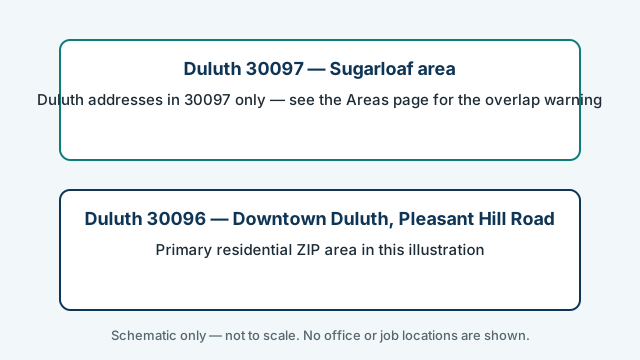
Call to discuss whether your leak is visible or hidden — and which service fits — before any wall, floor, or ground is opened in Duluth 30096 or 30097.