 Duluth Water Leak Detection ProsWater leak detection · Duluth, GA · Open 24 hours
Water Leak Detection FAQs - Duluth, GA
These FAQs answer the questions callers ask most about water leak detection in Duluth, GA, including cost, coverage in 30096 and 30097, methods, and emergencies. Each answer is short and direct. Call (770) 214-4798 if your question is not answered here.
Answers to the questions callers ask most often about water leak detection in Duluth, GA. Answers here match the homepage FAQs where they overlap. Cost answers give factors only — no fixed price is published, because none has been supplied.
How do I know if I have a hidden water leak?
The most reliable early sign is your water bill. If it rises with no change in use, water may be escaping somewhere you cannot see. Other signs are a meter that moves with every tap off, damp patches, a musty smell in one spot, a warm patch on a floor, lower pressure, or running water when nothing is on. Any one sign is worth a call.
Can a leak be found without breaking walls or floors?
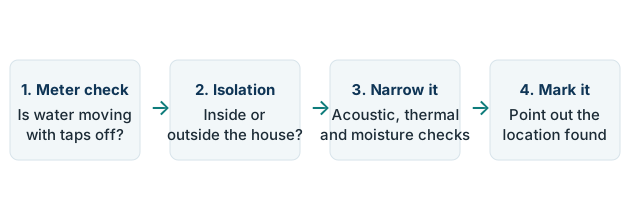
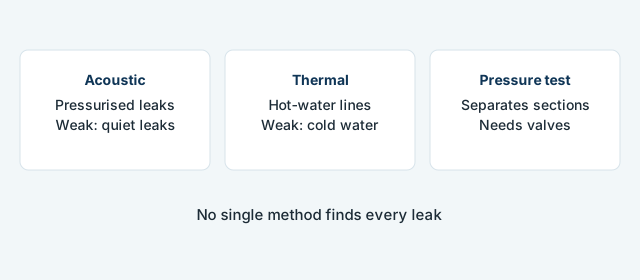
In many cases, yes — that is the point of detection. The inspection narrows the area first, using the meter test, isolation, and checks such as acoustic listening, thermal imaging, and moisture readings where they fit the leak. Cutting or opening is kept to the marked spot, and only after the location is discussed with you. No method finds every leak, and a careful inspection will say so when it cannot confirm a location.
How is this different from calling a general plumber?
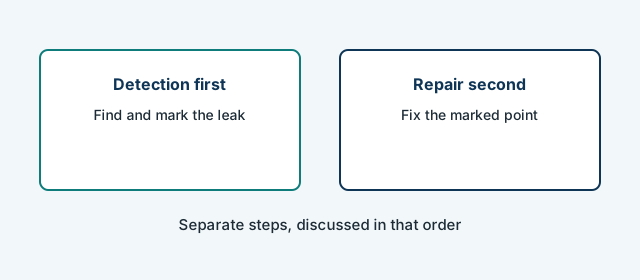
A general plumber is the right first call when you can see the leak — a dripping tap, a visible pipe, or a toilet connection. Detection is for when the source is hidden: behind a wall, under a slab, or underground. Detection finds the location first, so any repair that follows opens the right spot. In practice the two often follow each other: detection first, repair second.
What happens during a leak inspection?
It starts with what you are seeing and a meter check: with everything off, does the meter move? Then an isolation test helps separate an inside leak from a buried line. From there, the inspector narrows the area with the checks that fit the symptoms, marks the location found, and explains what the next step is. The full steps are on the How it works page.
How much does water leak detection cost in Duluth, GA?
We do not publish a fixed price, because the fee depends on the leak. The main factors are where the leak may be, how easy it is to reach, which checks are needed, and the size and layout of the property. Detection and repair are priced separately. Call with your symptoms and ZIP code and the cost factors for your case can be explained before you decide.
What should I do if water is showing right now?
If water is spreading, a ceiling is sagging, or you hear a steady rush inside a wall, shut off the main water valve if it is safe to reach, keep clear of wet electrical outlets and switches, and call. Do not touch wet electrics or wait overnight for an active leak. If you smell gas, leave and call your gas utility or emergency services — a different emergency, not handled by this number.
What areas around Duluth do you serve?
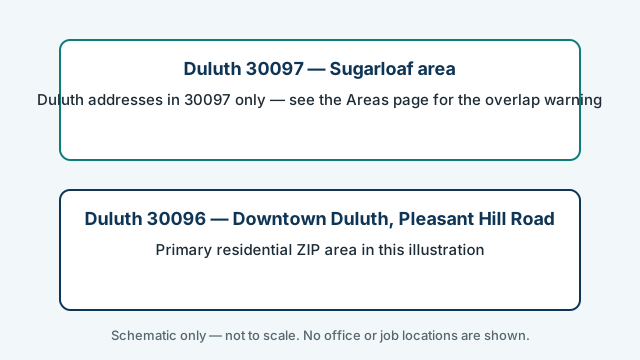
The main pages cover Duluth 30096, including Downtown Duluth and the Pleasant Hill Road area, and Duluth addresses in 30097, including the Sugarloaf area. The Areas page also lists the paid ZIPs 30095 to 30099 as coverage, with an honest warning: 30095 is a PO Box ZIP and 30098 and 30099 are unique ZIPs, so they do not get their own residential pages. Call with your address if you are unsure whether you are covered.
Does leak detection include leak repair?
No — detection and repair are different steps, and we do not include repair in detection. We locate the leak and explain what we found. What happens next — repair, rerouting, or referral — depends on the leak and is discussed after the location is known. Ask on the call what is included for your case, so there is no surprise later.
Can thermal imaging find every water leak?
No. Thermal imaging shows temperature patterns, so it works best on hot-water lines where the leaking water changes the surface temperature. It is weaker on cold-water leaks, where the temperature difference is small, and it does not see through walls. It is used to narrow an area, then combined with acoustic listening or moisture readings — not used as a single proof on its own.
How do I check my water meter for a leak?
Turn off every tap, appliance, and toilet cistern. Note the meter reading and the leak indicator if your meter has one. Wait 30 to 60 minutes without using water, or up to two hours for a slow leak, then read it again. Movement means water is escaping. Gwinnett County Water Resources publishes this guidance for its customers and offers free toilet dye-test kits — their guidance is linked below as an external authority.
External authority
Gwinnett County Water Resources publishes leak-detection guidance, notes that leaks on the homeowner's side of the meter are the homeowner's responsibility to repair, and offers free toilet leak-detection dye tablets. That guidance is general county information, not a statement about this business's coverage or pricing. The county's leak-detection page is the external source to check for meter and dye-test instructions.
Visual guides
Diagrams that summarise the pages above — all are illustrations, not photographs of jobs.

Call (770) 214-4798
Call to discuss what you are seeing and arrange a leak inspection.
Hours and credentials
Open 24 hours for emergency services. Licensed & Insured — full credentials are listed on the About page.