 Duluth Water Leak Detection ProsWater leak detection · Duluth, GA · Open 24 hours
Non-Invasive Water Leak Detection in Duluth, GA
Non-invasive water leak detection in Duluth, GA, in ZIP codes 30096 and 30097, finds a hidden leak with as little opening as possible. We use acoustic listening, thermal imaging, moisture readings, and pressure checks, and mark the location the checks agree on.
Non-invasive is not a separate leak type. It is the way the other services on this site are done. A slab leak, a wall leak, a water-line leak, and an underground leak are all found by narrowing first and opening only at a marked point. This page exists so that explanation is written once, in full, instead of repeated in shortened form on every service page. The service pages link here for their method detail, and this page links back to them for the symptoms and the service-specific steps.
What non-invasive means, and what it does not mean
Non-invasive means the search does not open walls, floors, or ground to find the leak. It does not mean no opening will ever be needed. If a pipe has to be repaired or replaced, that repair will open the marked point — but it will open that point, not a series of exploratory openings made to search. The distinction is the whole value of detection: a search that narrows first is cheaper and less disruptive than a search that cuts first, even when a repair opening follows.
Non-invasive also does not mean a single tool. Competitor pages sometimes present one method — usually thermal imaging or acoustic listening — as if it were the whole inspection. The honest version is a combination, chosen for the leak's symptoms and location, with each method's limit stated before it is used. A location that several checks agree on is more reliable than a location from any one check alone.
The methods, with their limits
| Method | What it does | Limit |
|---|---|---|
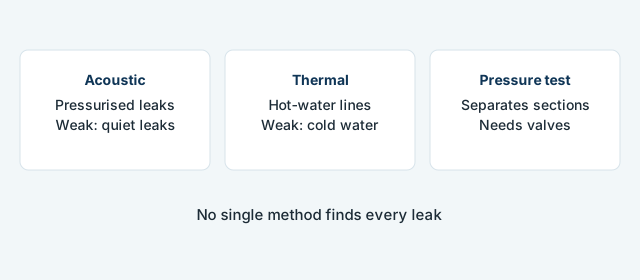
| Acoustic listening | Picks up the sound of pressurised water escaping from a pipe | Weak on slow or quiet leaks; masked by depth, coverings, and background noise |
| Thermal imaging | Reads surface temperature patterns to narrow a warm-water leak | Does not see through walls or concrete; weak on cold-water leaks |
| Moisture readings | Measures dampness in materials to map how far moisture has spread | Shows spread, not source — water travels before it surfaces |
| Pressure testing | Isolates a pipe section and checks whether it holds pressure | Needs valves and access points that may not exist for every section |
| Tracer gas | Introduces a traceable gas to a section and detects where it escapes | A later step for cases other checks cannot narrow, not a first step |
| Camera / borescope checks | Views inside a cavity or pipe where an opening already exists | Needs an access point; does not create one without opening |

Which method fits which leak
The fit depends on the leak's position and on whether the water is hot or cold. A slab leak on a hot-water line is a good thermal candidate, because the slab surface warms above the leak. A slab leak on a cold-water line is a poor thermal candidate and relies more on acoustic and pressure checks. A wall leak relies on moisture mapping plus acoustic narrowing, because the wall surface temperature may show little on a cold line. A water-line leak relies on section pressure testing, because interior lines offer valves and sections that a slab or yard line may not. A buried yard line relies on acoustic and pressure checks, because thermal imaging is of little use in wet ground and moisture readings cannot separate a leak from rain.
That fit is why the service pages do not each repeat the full method table. Each service page names the methods that fit its leak and links here for the full explanation and limits. If a method is proposed for a leak it does not fit — a thermal scan as the main check for a buried yard line in wet ground, for example — that mismatch is a reason to ask how it would work in those conditions, not a reason to accept the tool name at face value.
The narrowing sequence
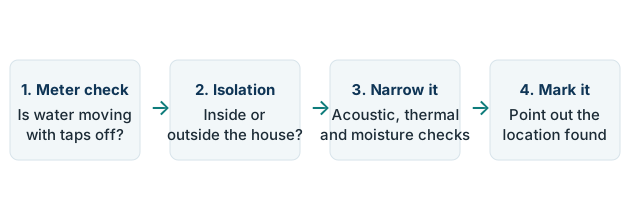
Regardless of the methods chosen, the sequence is the same, and it is the sequence that makes the methods non-invasive rather than exploratory. First, the meter test confirms a leak exists. Second, isolation separates inside from outside, and then section from section. Third, the chosen methods narrow the remaining section to a point or a small area. Fourth, that point is marked and explained, including how confident the narrowing is and what would confirm it further if confidence is low. Only after that point is marked is any opening discussed, and that opening is part of a repair, not part of the search.
Two cautions belong in this sequence. A location from a single method, without meter and isolation work, is a pattern, not a confirmed leak. And a location that several methods disagree on is not a location at all — it is a reason to run a further check, not a reason to open at the average of the disagreements. A careful inspection will say when it cannot confirm a location, rather than marking a guess.
What non-invasive detection does not do
It does not repair a pipe, reroute a line, or replace a section. It does not find gas, roof, or pool leaks, which are different trades with different methods. It does not guarantee a location on the first visit, because some leaks are slow, deep, or masked by coverings and conditions. It does not replace a general plumber for a visible leak, where the source is already known. What it does is give a marked location and a clear next step, with the evidence for that location explained in terms a homeowner can check — a meter result, a section that lost pressure, a thermal pattern, an acoustic signal — rather than a claim to trust on faith.
What affects the cost of a non-invasive inspection
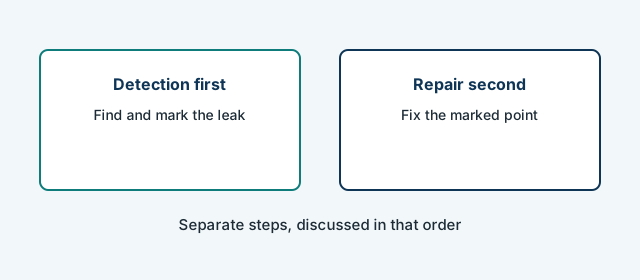
No fixed price is published here, because no price has been supplied and national ranges are not Duluth prices. For a method-based inspection, the fee moves with how many methods are needed, how much area has to be narrowed, whether section valves exist for pressure testing, whether conditions such as wet ground or noisy surroundings make acoustic work harder, and whether a later step such as tracer gas is needed because the standard checks cannot narrow the leak. Detection and repair are priced separately. Ask on the call which methods are planned for your symptoms and why, and what the inspection includes, before any work starts.
How to read an inspection result
An inspection result should be readable without trusting a tool name. A confident result states the meter result, the section that was isolated, the methods that agreed on the point, and what the next step is. A partial result states what was narrowed and what remains uncertain — for example, a section confirmed by pressure testing but a point narrowed only by one method, or a leak confirmed by the meter but a point that wet ground prevented from being narrowed. An inconclusive result states that plainly: the meter confirms a leak, the checks cannot yet confirm a point, and the next check that could confirm it is named. Each of those three results is honest, and each leads to a different next step. What is not honest is a partial or inconclusive result presented as a confident point, because that presentation is what leads to an opening in the wrong place.
Questions worth asking after any inspection are short and direct: what did the meter show, which section was isolated, which methods agreed on the point, and what would change the answer? If those questions cannot be answered, the result is not ready to base an opening on, however confident the mark looks. Keep the answers with the property, because a future plumber or a future buyer will need the same facts, and a marked point without its evidence is just a mark.
Safety and limits for non-invasive methods
Non-invasive methods are safe in the ordinary sense — they do not open surfaces or introduce hazards — but they have diagnostic limits that are safety-relevant in one case: a leak that cannot be confirmed should not be treated as confirmed. Opening a wall, a floor, or ground at a guessed point creates damage without fixing the leak, and it can cut into wiring or other services. If water is spreading, a ceiling is sagging, or you hear a steady rush, shut off the main valve if it is safe to reach, keep clear of wet electrics, and call. If you smell gas, leave and call your gas utility or emergency services.
Common questions about non-invasive leak detection in Duluth
What does non-invasive leak detection mean?
It means finding a leak without opening walls, floors, or ground to search for it. The inspection narrows the leak first, using checks such as acoustic listening, thermal imaging, moisture readings, and pressure testing, and any opening that follows is limited to the marked point. Non-invasive describes the search, not a promise that no opening will ever be needed for a repair.
Can acoustic listening find any leak?
No. Acoustic listening picks up the sound of pressurised water escaping, so it works best on a leak that is still under pressure and producing a clear signal. Depth, soil or wall coverings, pipe material, and background noise all affect it. A slow leak may be quiet, and a noisy environment may mask it. That is why it is combined with other checks.
Can thermal imaging see through walls or floors?
No. Thermal imaging reads surface temperature patterns; it does not see through a wall, a floor, or concrete. It works best on hot-water lines, where leaking water changes the surface temperature. It is weaker on cold-water leaks, where the temperature difference is small, and it is affected by surface coverings and by sun or heating on the surface.
What is a moisture meter used for?
A moisture meter measures how damp a material is, which shows how far moisture has spread from a leak. It does not, on its own, show where the pipe broke, because water travels through materials before it surfaces. It is used to map the damp area and to support the narrowing from acoustic or thermal checks, not as a single location proof.
What is pressure testing in leak detection?
Pressure testing isolates a section of pipe and checks whether it holds pressure. A section that loses pressure contains the leak; a section that holds does not. It is the most decisive method for separating sections, but it needs valves and access points that may not exist for every section in every home.
Why use more than one method?
Because each method has a limit, and the limits do not overlap in the same way. Thermal is weak on cold water, acoustic is weak on quiet leaks, moisture shows spread rather than source, and pressure needs access. Combining them lets one method cover another's weakness, and a location that several checks agree on is more reliable than a location from a single check.
Call (770) 214-4798
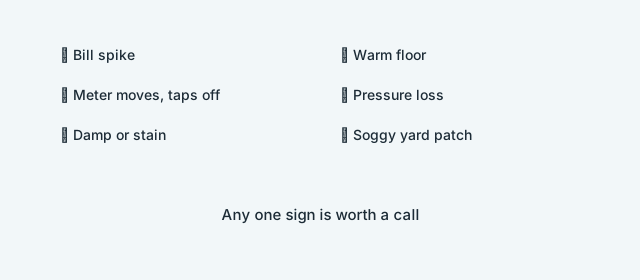
Call to discuss which methods fit your symptoms — a warm floor, a damp wall, a moving meter, or a wet yard — and arrange a non-invasive leak inspection in Duluth 30096 or 30097.