 Duluth Water Leak Detection ProsWater leak detection · Duluth, GA · Open 24 hours
How to Check Your Water Meter for a Leak in Duluth, GA
To check your water meter for a leak in Duluth, GA, turn every tap off, read the meter, wait without using water, then read it again. If it moved, water is escaping somewhere. If it did not move, you do not have a hidden leak question from the meter alone.
The meter test is the simplest leak check a homeowner can do, and it is also the most honest one. It does not find a leak's location, and it does not fix anything. What it does is answer a yes-or-no question that every other step depends on: is water leaving your system when nothing is using it? If the answer is yes, you have a leak question worth a call. If the answer is no, your problem is more likely usage, a single appliance, or a billing question — and that distinction can save you an inspection you did not need.

Why the meter test works
Your water meter measures every litre that passes into your home. When every tap, toilet, appliance, and irrigation control is off, nothing should pass through it. If the meter still moves, water is going somewhere — through a pipe, a toilet, or an appliance you thought was off. That logic is why the test is used by water utilities, including Gwinnett County Water Resources, whose published guidance for Duluth customers describes the same check. It is not a trick or a shortcut; it is the same first step a professional inspection starts with.
The test works because a hidden leak runs continuously. A visible drip wastes water in drops you can see. A concealed leak — under a slab, behind a wall, on a buried line — wastes water around the clock, at pressure, whether you are home or not. That continuous flow is what makes the meter move, and it is also what makes a bill climb before any dampness appears. A leak that only ran when a tap was open would not move a meter with everything off, and it would not be a hidden-leak question in the first place.
Step by step: the meter test
- Turn everything off. Every tap, shower, toilet cistern, washing machine, dishwasher, and irrigation controller. Check that no one in the house is about to use water during the test, and note any appliance that runs on a timer.
- Find your meter and note the reading. Write down the full reading, including the smallest dial or digit, and note whether your meter has a leak indicator — a small triangle, star, or dial that moves with even a tiny flow. A photograph of the meter helps you compare readings accurately.
- Wait without using water. Thirty to sixty minutes is a common check. For a slow leak, up to two hours gives a clearer result, because a very slow leak may barely move the smallest dial in half an hour. Do not flush, run a tap, or start an appliance during the wait.
- Read the meter again. Compare the new reading with the first. Any movement means water passed through the meter during the wait. No movement means nothing passed through — at least, nothing that this test could detect in that time.
- Do the shutoff test next. Close the house shutoff valve and watch the meter again. If it stops, the leak is inside the house. If it keeps moving, the leak is likely on the buried line outside. That one test decides whether the water line question or the underground question answers your case.
Reading different meter types
Not every meter looks the same, and the reading method changes slightly with the type. An analogue meter has dials and often a small leak indicator that spins with tiny flows — watch that indicator first, because it moves before the main numbers change. A digital meter shows a numeric total and sometimes a flow rate; a flow rate above zero with everything off is the same signal as a moving dial. Some meters are in a pit near the street and may need a lid lifted to read — keep clear of the pit, do not reach into standing water, and if the meter is inaccessible or damaged, call rather than forcing it.
Whatever the type, write the reading down rather than trying to remember it. A photograph is better still, because the smallest digit is easy to misread from memory, especially on an analogue dial. If you are unsure whether a dial moved, repeat the test for a longer wait rather than guessing from a single reading. A longer wait is free, and a guessed result is worse than no result.
What the result means
| Result | Meaning | Next step |
|---|---|---|
| Meter moves, everything off | Water is escaping somewhere | Shutoff test, then call with the result |
| Meter stops with shutoff closed | Leak is inside the house | Water line, wall, or slab question |
| Meter keeps moving, shutoff closed | Leak is likely on the buried line | Underground question |
| Meter does not move | No leak detectable by this test | Check toilets, appliances, usage, billing |
| Meter moves very slowly | Slow leak, or a toilet/appliance | Longer wait, then toilet and appliance checks |
The table is a guide, not a diagnosis. A meter that does not move does not prove there is no leak at all — a very slow leak may need a longer wait to show, and an intermittent leak may not run during your test window. A meter that moves does not prove a pipe leak — a running toilet or a faulty appliance moves a meter too. That is why the next steps after the test are checks, not conclusions: toilets first, then appliances, then the shutoff test, then a call with all three results.
Common false positives — check these before you assume a pipe leak
- Toilets. A silent toilet leak — a worn flapper letting cistern water into the bowl — is the most common meter mover that is not a pipe leak. Dye-test it: put dye in the cistern, wait without flushing, and check whether colour appears in the bowl.
- Appliances on timers. A washing machine, dishwasher, water softener, or irrigation controller that runs during the test will move the meter. Note any timer-driven appliance before you start, and run the test when none are due.
- Irrigation. An irrigation system that leaks or runs on a schedule can move a meter and wet a yard without any pipe leak in the house system. Turn irrigation off for the test and note whether the yard wetness matches its schedule.
- A tap left dripping. A tap that drips steadily is using water, and it will move a meter. It is also a visible leak, not a hidden one — fix the tap, then re-test if the meter still moves.
- Recent use. A toilet flushed just before the test, or a cistern refilling when you take the first reading, will make the second reading look like movement. Wait for all cisterns to finish refilling before you take the first reading.
When the meter test is not enough
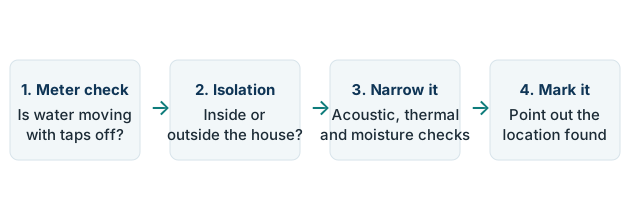
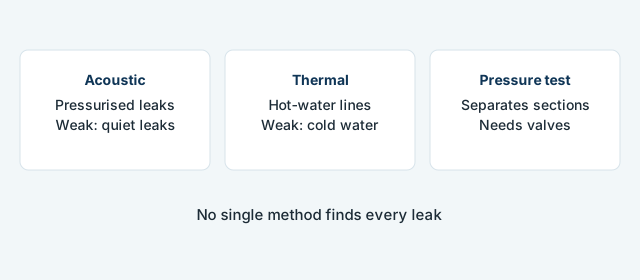
The meter test confirms a leak exists; it does not locate it. That is the point where a professional inspection takes over, using the narrowing steps described on the How it works page: isolation, then acoustic, thermal, moisture, and pressure checks chosen for the symptoms. If your meter moves but you cannot tell whether the leak is inside or outside, the shutoff test is the next step, and if that is inconclusive, the inspection will start from the meter result itself rather than from a guess.
There are also cases where the meter test cannot be done safely or accurately: a meter that is damaged, flooded, or inaccessible; a property with a shared meter where other units use water during the test; or a leak that only runs intermittently, such as a pipe that leaks only when a particular fixture is used. In those cases, describe the situation on the call rather than forcing a test result. A test that cannot be trusted is worse than no test, because it can point the inspection in the wrong direction.
Gwinnett County guidance and the dye test
Gwinnett County Water Resources publishes meter-test guidance for its customers and offers free toilet leak-detection dye tablets. That guidance is general county information, and it is the external authority cited on the FAQs page for this test. The county also notes that leaks on the homeowner's side of the meter are the homeowner's to repair — a general rule, not a ruling on a particular property, and a reason to check with the county if a leak is near the meter or a boundary before authorising work. Use the county's guidance for the test itself; use the call for questions about your specific property.
What to tell us when you call
A caller who has done the meter test can make the call much shorter and more useful by bringing five facts: whether the meter moved, whether it stopped with the shutoff closed, how long the wait was, whether toilets and appliances were ruled out, and what symptoms prompted the test in the first place — a bill spike, a damp wall, a warm floor, or a wet yard. Those facts let the right service be identified on the call, and they let the inspector know which checks to start with. A caller who has not done the test can still call; the test can be talked through on the phone, and the inspection will start from the same steps in person.
Common questions about checking a water meter for a leak
How long should I wait between meter readings?
Thirty to sixty minutes is a common check, and up to two hours gives a clearer result for a slow leak. The point is to wait without using any water in between — a toilet flush, a washing machine, or an irrigation cycle during the wait will move the meter and ruin the test. If you cannot avoid using water for that long, note the use and interpret the result with that in mind, or run the test at a quiet time such as overnight.
What if my meter has no leak indicator?
Read the numbers instead. Note the full reading, including the smallest dial or digit, wait without using water, and read it again. Any movement in the smallest unit means water passed through the meter. A digital meter may show a flow rate as well as a total — a flow rate above zero with everything off points the same way as a moving dial.
Can a toilet really move a meter that much?
Yes. A toilet that runs silently — a worn flapper letting water leak from the cistern into the bowl — can waste a surprising amount of water without any visible sign. That is why toilets are ruled out before a pipe leak is assumed. A dye test, using a dye tablet or food colouring in the cistern, will show colour in the bowl within minutes if the flapper is leaking, without flushing.
Does the meter test tell me where the leak is?
No, and that limit matters. The meter test tells you whether water is escaping, and, with the shutoff test, whether it is inside or outside. It does not tell you which pipe, which wall, or which section. That narrowing is the inspection's job, using acoustic, thermal, moisture, and pressure checks. A meter result is the starting point for that inspection, not a substitute for it.
Should I do the meter test before I call?
It helps, but it is not required. A caller who has done it can say whether the meter moved and whether it stopped with the shutoff closed, which lets the right service be identified on the call. A caller who has not done it can still call — the test can be talked through on the phone, and the inspection will start from the same steps in person.
Visual guides
Diagrams that summarise the pages above — all are illustrations, not photographs of jobs.
Call (770) 214-4798
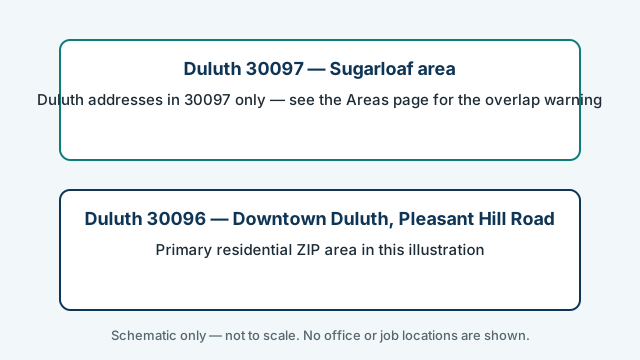
Call with your meter result — moved or not, and what the shutoff test showed — to arrange a leak inspection in Duluth 30096 or 30097.